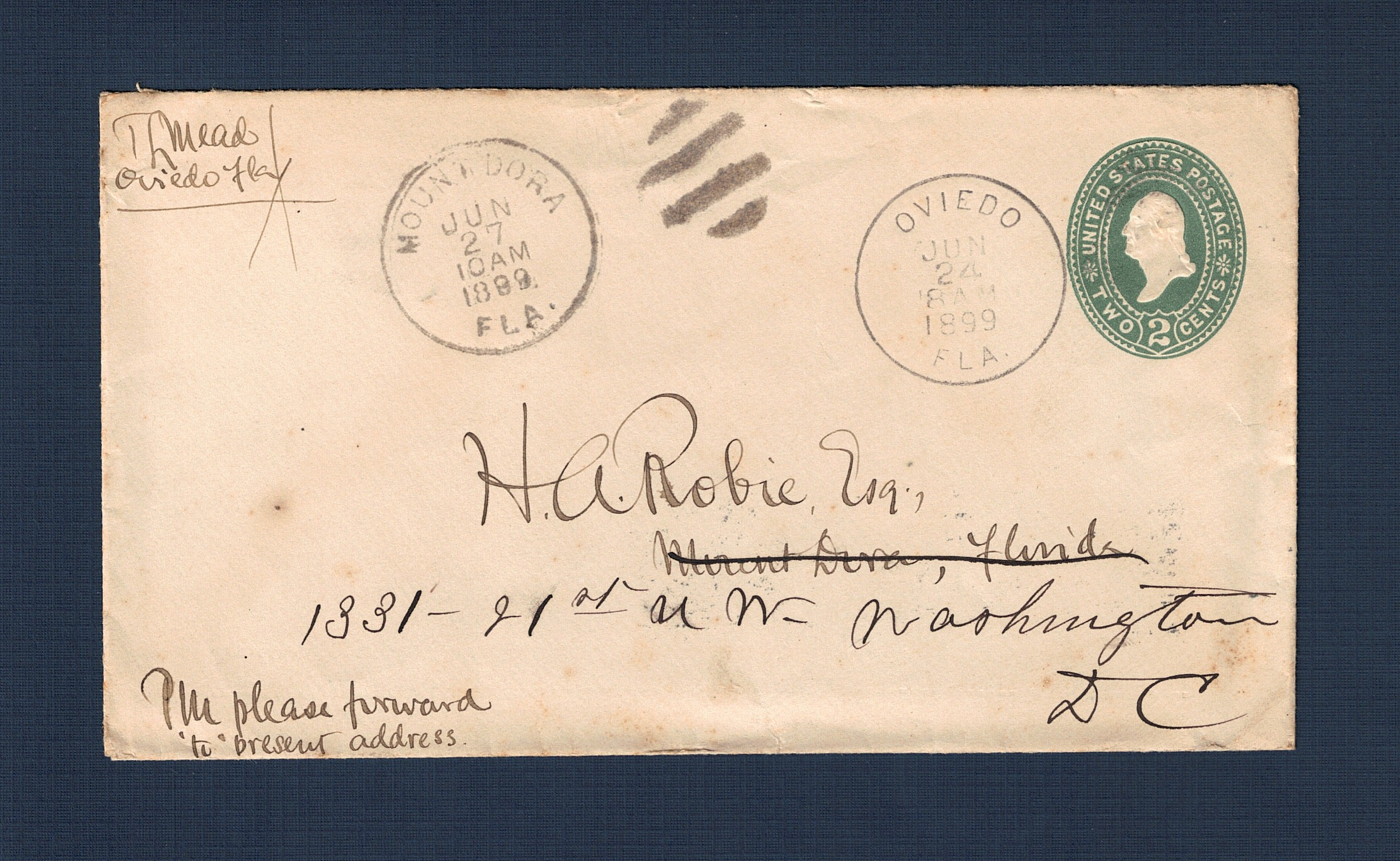
This 1899 postal cover offers a fascinating look at the "forwarding" process of the late 19th-century mail system. Sent by T. L. Mead from Oviedo, Florida, on June 24 at 8 AM, the letter was originally addressed to H. A. Robie, Esq. in Mount Dora, Florida. The envelope features a green two-cent George Washington stamp and a clear Oviedo dispatch postmark.
The transit path of the letter shows it arrived in Mount Dora on the same day it was sent, as evidenced by the faint June 24 backstamp. However, because the recipient was no longer there, the original address was struck through and a new destination in Washington, D.C. was handwritten below it. A note in the lower left corner "PM please forward to present address" likely stands for "Postmaster," requesting the redirection. The letter was re-processed in Mount Dora on June 27 at 10 AM, as shown by the second circular postmark on the front and a corresponding killer cancel over the stamp.
The journey concluded in the nation's capital just two days later. The reverse side of the envelope bears a crisp Washington, D.C. receiving stamp dated June 29 at 12:30 AM. This final mark completes a journey that saw the letter travel from a small Central Florida town to a neighboring village, only to be redirected over 800 miles north to an address on 21st Street NW, all within a five-day window. This efficient redirection illustrates the high level of service and coordination provided by the railway mail system during this era.
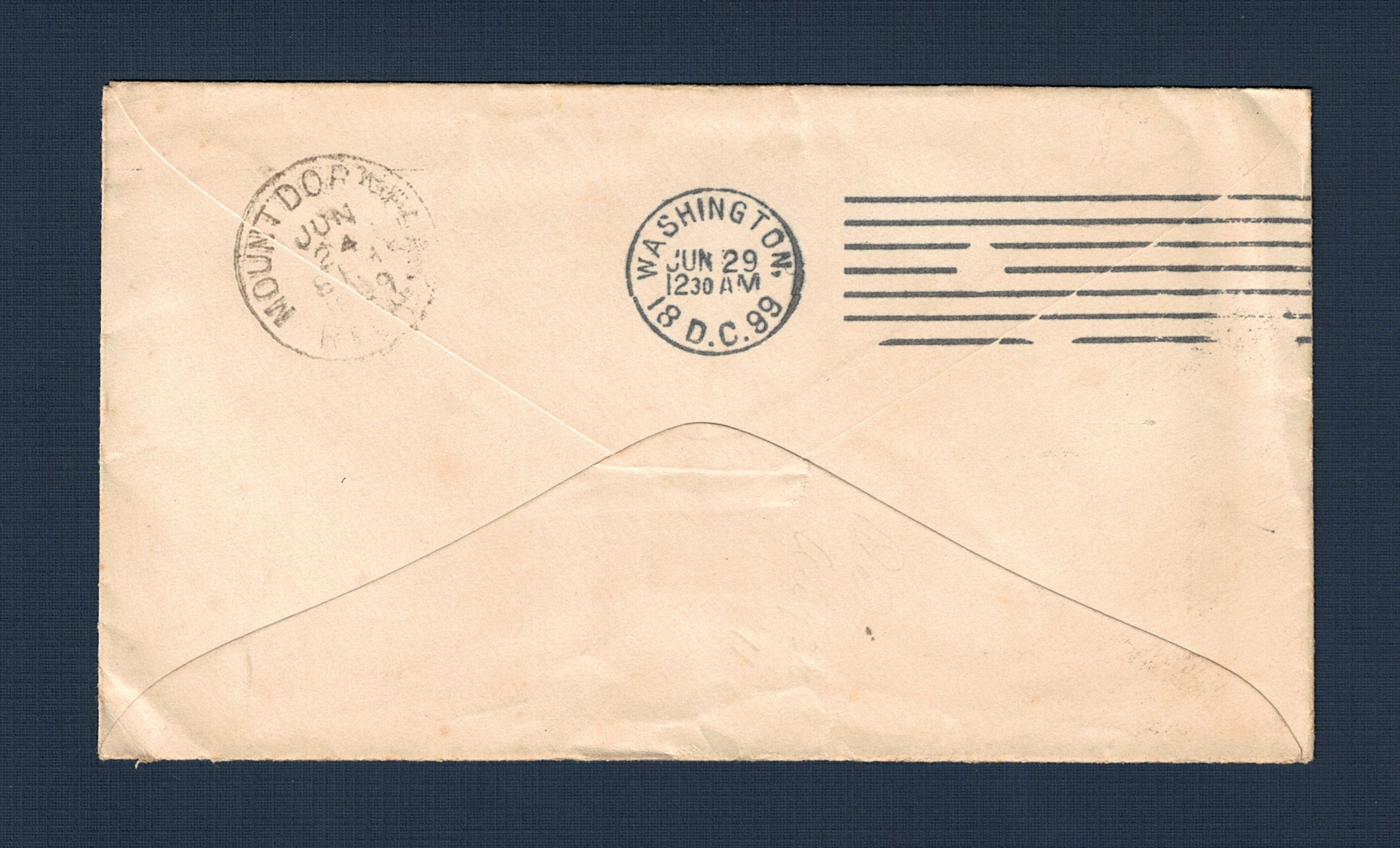
The reverse of this 1899 envelope features two distinct circular postmarks that meticulously trace the letter's journey and subsequent redirection. On the left side, the Mount Dora, Florida, postmark is dated June 24, 1899. This mark serves as a receiving stamp, confirming that the correspondence reached its initial destination on the very same day it was dispatched from Oviedo, reflecting the high frequency of local rail mail service at the end of the century.
At the center of the envelope, a second postmark represents the conclusion of the letter's forwarded journey to the nation's capital. This Washington, D.C., stamp is dated June 29, 1899, at 12:30 AM. It is accompanied by a "killer" cancel consisting of several horizontal bars, which was a standard postal practice of the era to signify the final processing at a major distribution hub. Together, these marks illustrate a five-day transit period from rural Florida to a specific urban address in the District of Columbia.