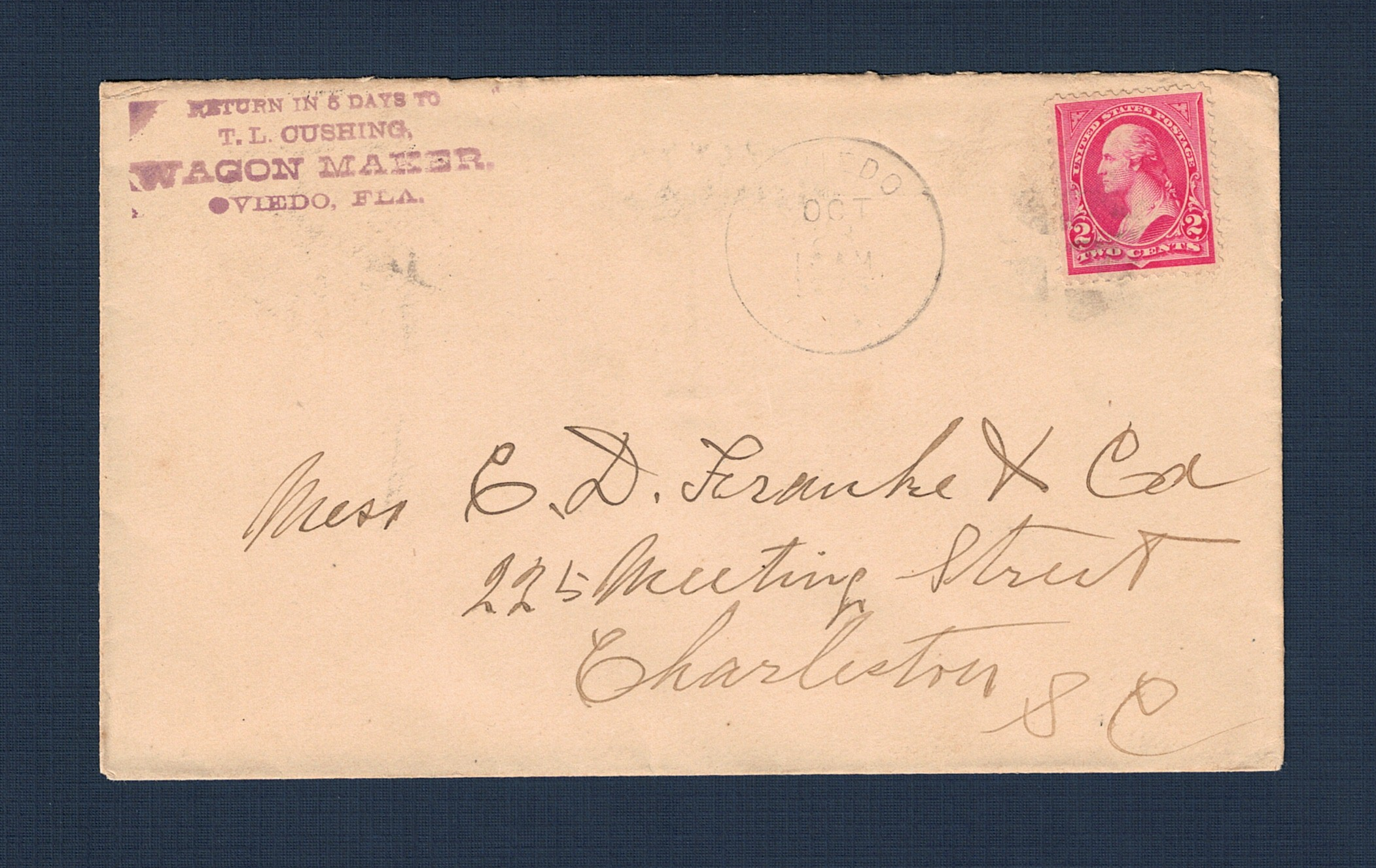
This 1895 postal cover was dispatched from Oviedo, Florida, to the firm of C. D. Franke & Co. in Charleston, South Carolina, on October 22. The envelope features a carmine two-cent George Washington stamp and a faint Oviedo circular postmark. Notably, it bears a purple stamped return address for T. L. Cushing, a local wagon maker in Oviedo. Given that C. D. Franke & Co. was a prominent wholesaler of iron, steel, and wagon materials, this correspondence likely represents a business order for the specialized hardware needed to maintain and build horse-drawn vehicles.
During the mid-1890s, the transportation landscape of Central Florida was in a period of significant transition. While the expansion of the South Florida Railroad had connected rural towns like Oviedo to national markets, wagons remained the essential "last mile" technology for daily life. In an era before paved roads, high-wheeled wagons were the only reliable means of hauling heavy loads of citrus and timber through the deep, sandy tracks of the Florida scrub to the nearest rail depot.
A local craftsman like T. L. Cushing served a vital role in this community, acting as both a manufacturer and a mechanic. He was responsible for the complex task of repairing wooden wheels, axles, and ironwork that frequently suffered under the strain of the rugged local terrain. While 1895 represented a peak for the horse-and-wagon industry, the arrival of the bicycle craze and the early development of the gasoline engine signaled the beginning of a shift that would eventually render the traditional wagon maker's trade obsolete.
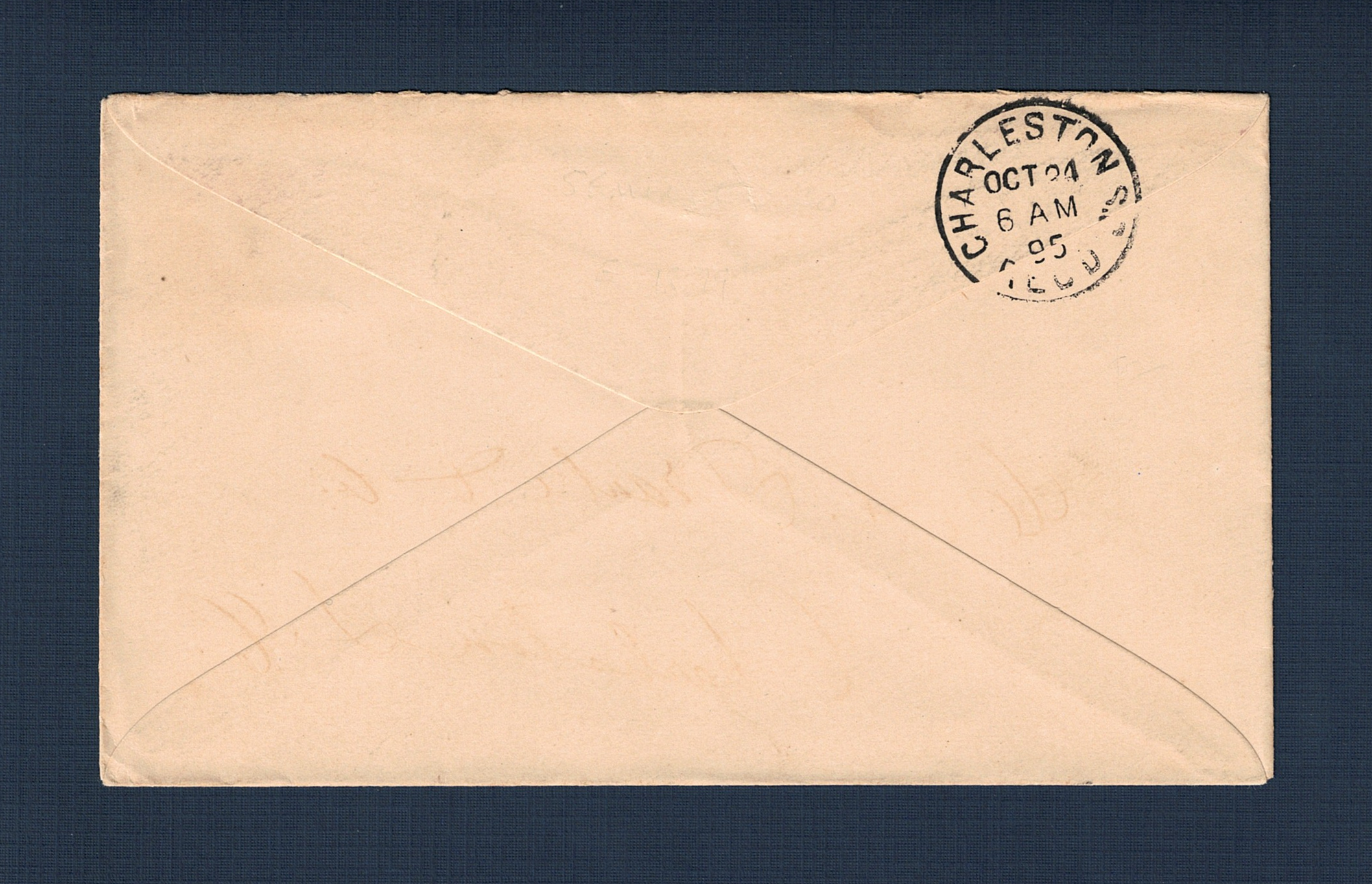
The reverse of this 1895 envelope features a remarkably crisp receiving backstamp from Charleston, South Carolina. The circular postmark indicates the letter arrived at the Charleston post office at 6 AM on October 24, 1895, just two days after it was mailed from Oviedo, Florida.
This short transit time highlights the efficiency of the late 19th-century railway mail system. For a letter to travel from a small town like Oviedo to a major coastal city in South Carolina in approximately 48 hours, it likely moved via the South Florida Railroad to a larger hub like Sanford or Jacksonville, where it would have been transferred to a fast-moving northbound mail train.
Additionally, the back of the envelope shows subtle ghosting of the handwriting from the front, a result of the ink's pressure or slight bleed-through over more than a century. The paper remains in excellent condition, with the original adhesive flap still clearly defined, providing a clean example of 1890s postal stationery.