Oviedo’s Post Office Prior to WWI
← Previous | Home | Next →
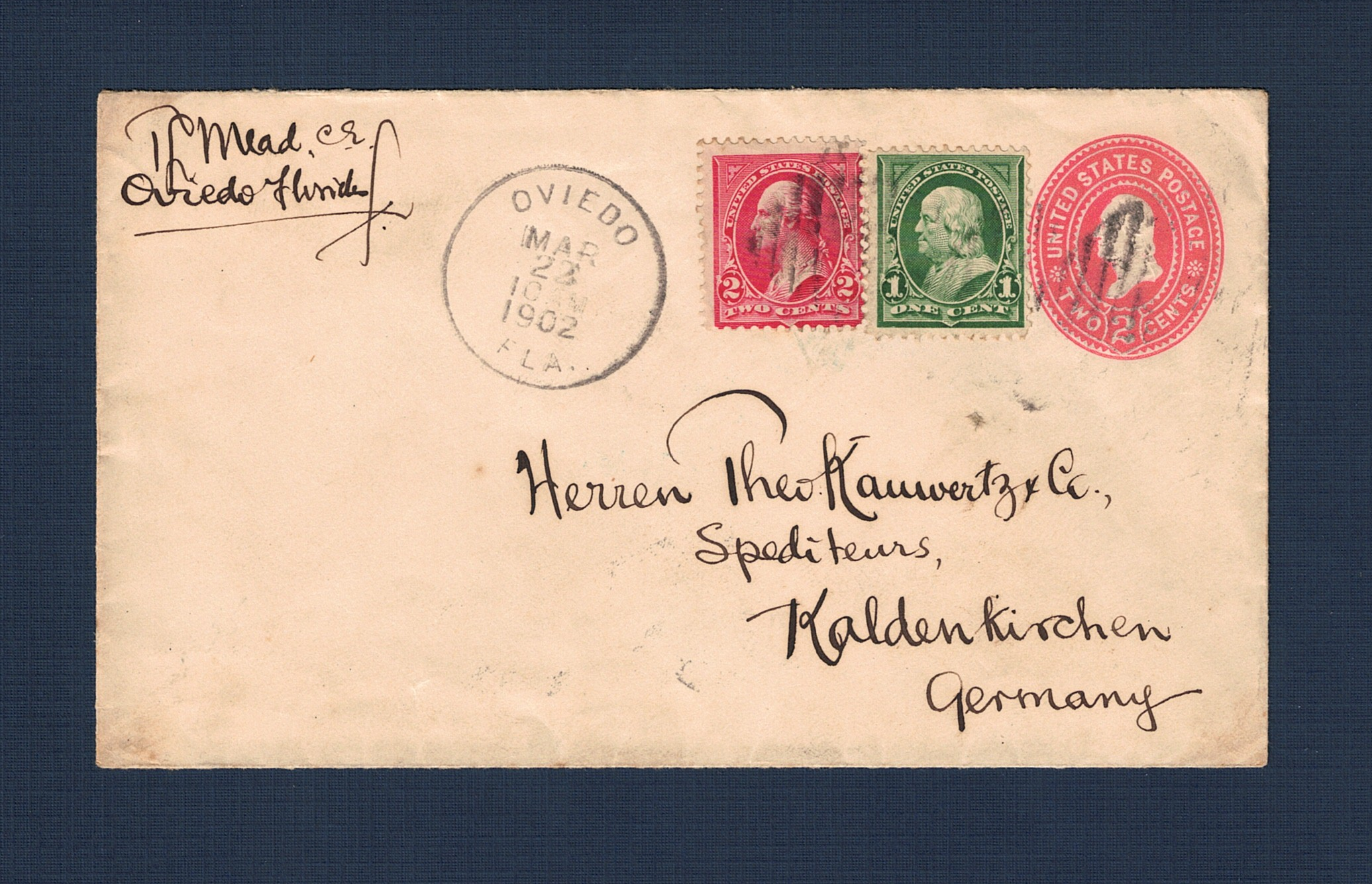
This 1902 international cover showcases the impressive logistics of the turn-of-the-century postal system, carrying correspondence from Theodore L. Mead in Oviedo, Florida, to Kaldenkirchen, Germany. Dispatched from the Oviedo post office on March 22 at 10 AM, the letter was franked with a combination of a two-cent carmine Washington stamp and a one-cent green Franklin stamp, meeting the five-cent international rate alongside the two-cent indicia of the postal stationery. The transit was remarkably swift for the era; backstamps reveal the letter reached a major export hub at the New York, N.Y. Foreign Branch by March 24 at 2 PM, just two days after leaving rural Florida.
From New York, the letter would have boarded a transatlantic steamship for the journey to Europe. The final destination of Kaldenkirchen, located in the Rhineland near the Dutch border, was a significant hub for trade and transport, fitting for the recipient, Herren Theo. Kauwertz & Co., who were listed as Spediteurs (freight forwarders). A faint, blue circular receiving stamp on the reverse indicates its arrival in Germany, marking the completion of a multi-modal journey across an ocean and two continents in what was likely under two weeks.
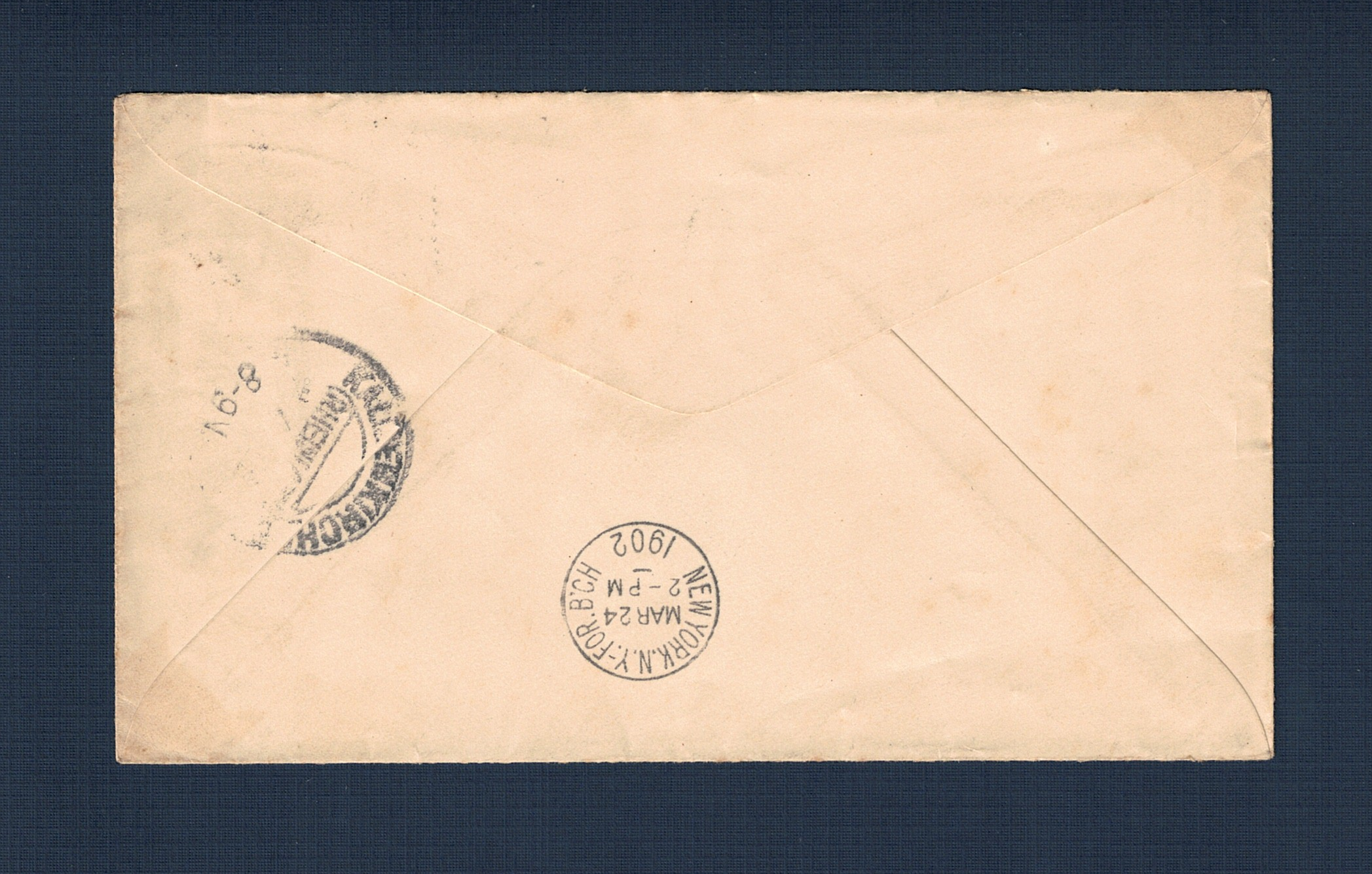
The reverse of this 1902 international cover features two distinct circular postmarks that document its transition from the domestic rail system to the transatlantic mail service:
The first mark is a clear NEW YORK, N.Y. FOR. B'CH (Foreign Branch) transit stamp, dated MAR 24, 2 PM, 1902. This indicates the letter arrived at the New York City hub for international sorting just two days after being dispatched from Oviedo. The second mark, located on the left, is a blue German receiving stamp from KALDENKIRCHEN (RHEINPARD). While the specific day is partially obscured by the envelope's flap, the year 02 and the time 8-9 V (8 to 9 AM) are legible, confirming the letter's arrival in the German Rhineland.
← Previous | Home | Next →